This week
Lessons 21, 22, 23, 24, & 25
Converting Measures To change from a larger unit to a smaller unit we multiply To change from a smaller unit to a larger unit we divide
Steps for Converting Measures: • Decide to multiply or divide • How many smaller units equal the larger unit? • Solve
Convert the following measures.
48 oz. = 3 lb. 7 tons = 14,000 lbs. 1. X 1. X

4 tablespoons = 12 teaspoons 5 hours = 300 minutes

Solving Measurement Equations with Differing Units
To solve measurement equations: • Rewrite the equation using the desired unit • Draw a box around the different measures • Convert • Solve
Solve the measurement problem.
15 tsp. + 4 tbsp. = 9 tbsp. 5 tbsp. + 4 tbsp = 9 tbsp.
1. ÷

54 ft. − 4 yd. = 14 yd. 3 gal. + 6 qt. = 18 qt.
2 lb. − 8 oz. = 24 oz. 112 fl. oz. - 7 cups = 7 cups
Square Numbers and Square Roots
Exponents tell us how many times to multiply the base. If the exponent is 2 we say the base is squared.
bbbb 52 eeeeeeee means 5 × 5
The opposite of squaring a number is to find the square root.
√16 = 4 because 4 × 4 = 16
Exponents and square roots are the second step in the order of operations. Remember PEMDAS.
P = Parentheses E = Exponents and roots MD = Multiply and divide left to right AS = Add and subtract left to right
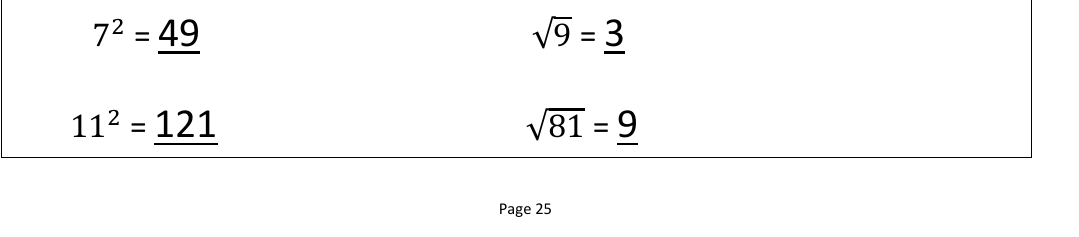
Write the value of each. 82 = 64 √100 = 10 62 = 36 √25 = 5
Write the value of each.
Word Problem Strategies • Underline or highlight what the problem is asking you to find • Circle all needed information • Cross out the extra information • Decide which math operation (or operations) you need to use to solve the problem • Solve and check
Timothy is turning 9 next week. He is having a skating party. He invited 25 friends. Four friends cannot attend. How many friends are coming to Timothy’s party?
Underline what the problem is asking. How many friends are coming? Circle the needed information. 25 friends invited; 4 cannot come Cross out extra information. Timothy is turning 9. What operation? Subtraction Solve and check 25 - 4 = 21 friends 21 + 4 = 25
Friendly Critter Daycare for animals is growing fast! Last year, they had 25 dogs and 10 cats each day. This year, they have twice as many dogs and three times as many cats as last year! How many dogs and cats are at the daycare this year?
25 × 2 + 10 × 3 = 80 animals
| Work-text | Lesson 21 | Lesson 22 | Lesson 23 | Lesson 24 | Lesson 25 |
|---|---|---|---|---|---|
| Speed drill | 21 | 22 | 23 | 25 |
| Term | Meaning |
|---|---|
| converting measures | To change from a larger unit to a smaller unit we multiply |
| box | • Draw a box around the different measures |
| different | • Draw a box around the different measures |
| squared | exponent is 2 we say the base is squared. |
| root | The opposite of squaring a number is to find the square root. |
| second | Exponents and square roots are the second step in the order of |
| underline | • Underline or highlight what the problem is asking you to find |
| asking | • Underline or highlight what the problem is asking you to find |