This week
Lessons 26, 27, 28, 29 & 30
Data: Range, Mode, Mean and Median
Draw a line from each vocabulary word to its definition. Range The data that appears most often Mode The average of the data Median Difference between the largest and smallest values Mean The middle value when in order from least to greatest
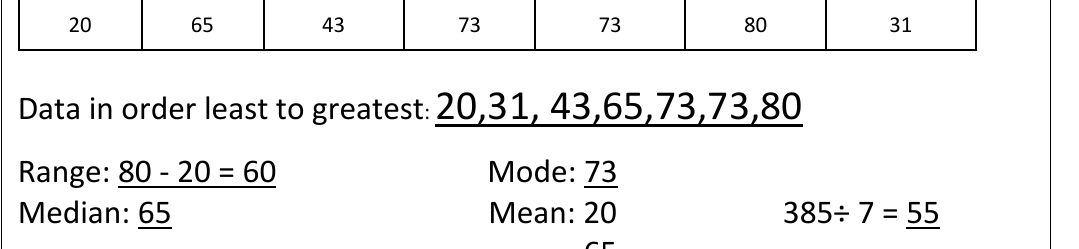
Find the range, mode, mean, and median for the set of data. Number of Surfers at Surfrider Beach March April May June July August September
20 65 43 73 73 80 31
Data in order least to greatest: 20,31, 43,65,73,73,80 Range: 80 - 20 = 60 Mode: 73 Median: 65 Mean: 20 385÷ 7 = 55
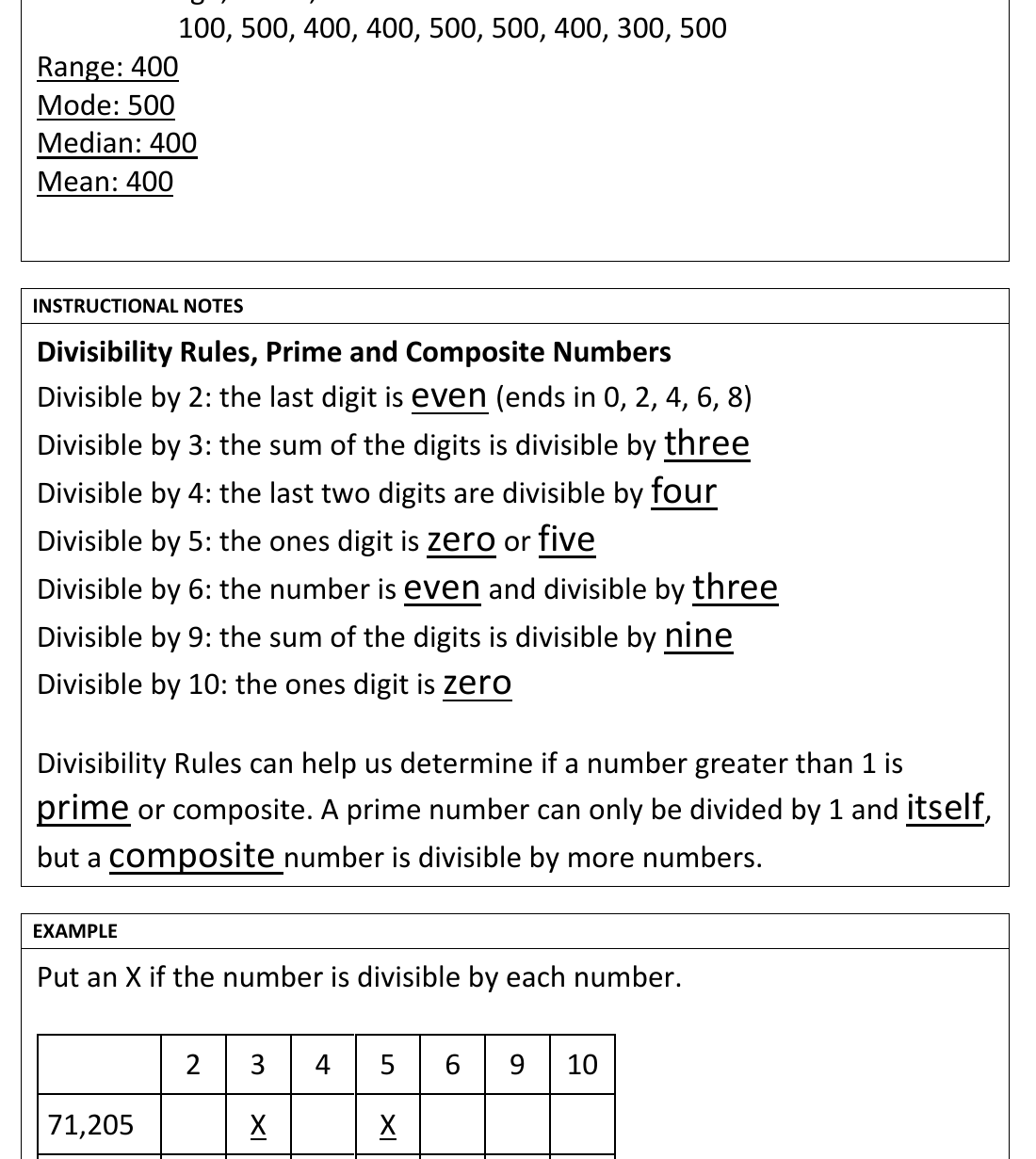
Find the range, mode, median and mean of the numbers. 100, 500, 400, 400, 500, 500, 400, 300, 500 Range: 400 Mode: 500 Median: 400 Mean: 400
Divisibility Rules, Prime and Composite Numbers Divisible by 2: the last digit is even (ends in 0, 2, 4, 6, 8) Divisible by 3: the sum of the digits is divisible by three Divisible by 4: the last two digits are divisible by four Divisible by 5: the ones digit is zero or five Divisible by 6: the number is even and divisible by three Divisible by 9: the sum of the digits is divisible by nine Divisible by 10: the ones digit is zero
Divisibility Rules can help us determine if a number greater than 1 is prime or composite. A prime number can only be divided by 1 and itself, but a composite number is divisible by more numbers.
Put an X if the number is divisible by each number.
601,380 X X X X X X X
Identify each number as prime, composite or neither.
15 Composite 19 Prime 218 Composite
Put an X if the number is divisible by each.
2 3 4 5 6 9 10 4,200 X X X X X X 3, 675 X X
Prime or Composite? 36 Composite 7 Prime 2 Prime
31 Prime 21 Composite 9 Composite
Factoring
Factors are multiplied together to find the product.
2 × 3 = 6, so 2 and 3 are factors of 6.
Find all the factors of 12. Pairs of Factors Factors of 12 = 1, 2, 3, 4, 6, 12
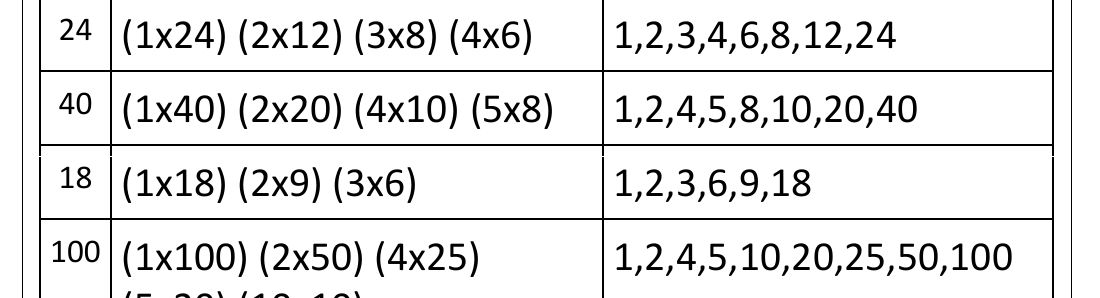
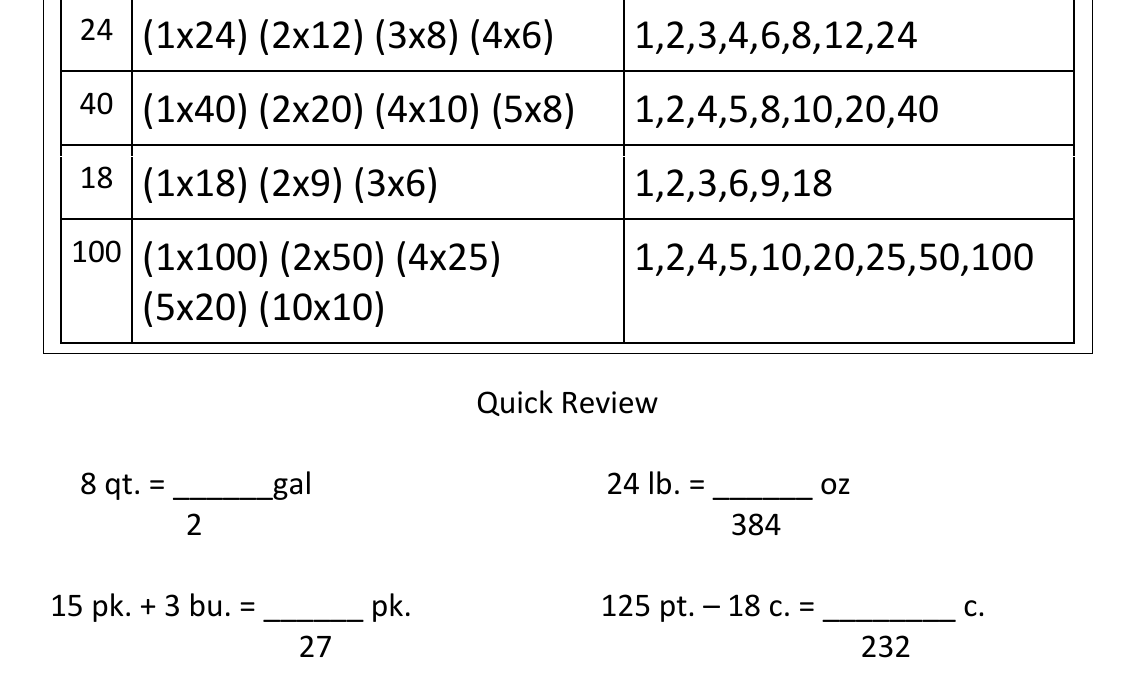
Find the factors of each number.
Pairs of Factors Factors List

| Work-text | Lesson 26 | Lesson 27 | Lesson 28 | Lesson 29 | Lesson 30 |
|---|---|---|---|---|---|
| Speed drill | 26 | 27 | 28 | 30 |
| Term | Meaning |
|---|---|
| range | The data that appears most often |
| mode | The average of the data |
| median | Difference between the largest and |
| mean | The middle value when in order from |
| even | Divisible by 2: the last digit is even (ends in 0, 2, 4, 6, 8) |
| three | Divisible by 3: the sum of the digits is divisible by three |
| four | Divisible by 4: the last two digits are divisible by four |
| zero | Divisible by 5: the ones digit is zero or five |