This week
Lessons 31, 32, 33, 34, & 35
Common Factors and Greatest Common Factor (GCF) Common Factors are factors that two or more numbers have in common. The greatest common factor (GCF) is the largest factor two or more numbers have in common. To find the GCF: • List all factors of each number • Circle the common factors • The largest one is the GCF
Find the GCF of 12 and 20. Pairs of Factors Factors Common Factors
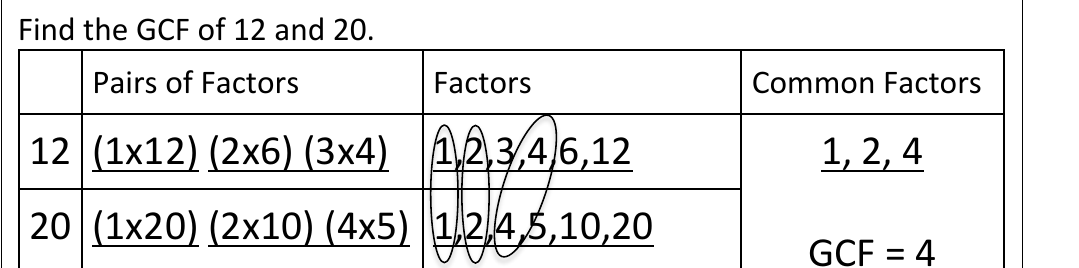
GCF = 4
Find the Greatest Common Factor. Pairs of Factors Factors Common Factors 18 (1 × 18) (2 × 9) (3 × 6) 1,2,3,6,9,18 1, 2, 3, 6
24 (1 × 24) (2 × 12) (3 × 8) 1,2,3,4,6,8,12,24 (4 × 6) GCF = 6
Pairs of Factors Factors Common Factors 16 (1 × 16) (2 × 8) (4 × 4) 1,2,4,8,16 1, 2, 4
20 (1 × 20) (2 × 10) (4 × 5) 1,2,4,5,10,20 GCF = 4
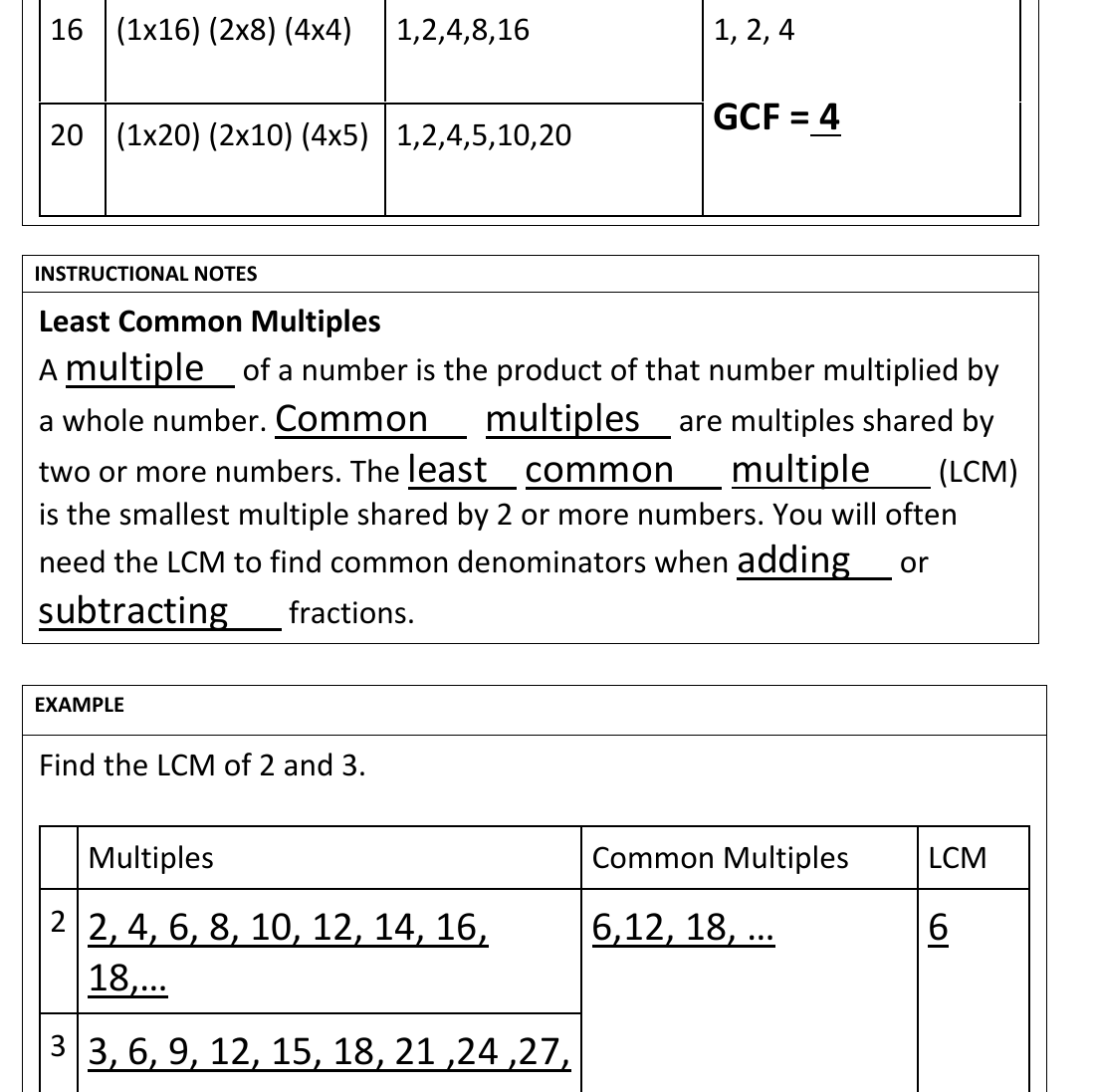
Least Common Multiples A multiple of a number is the product of that number multiplied by a whole number. Common multiples are multiples shared by two or more numbers. The least common multiple (LCM) is the smallest multiple shared by 2 or more numbers. You will often need the LCM to find common denominators when adding or subtracting fractions.
Find the LCM of 2 and 3.
Multiples Common Multiples LCM
...
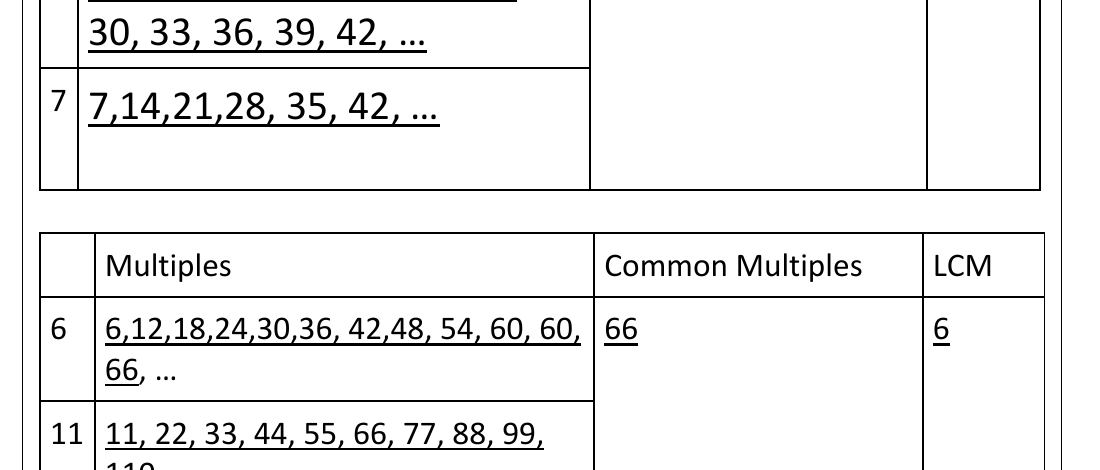
Find the least common multiple. Multiples Common Multiples LCM

Multiples Common Multiples LCM
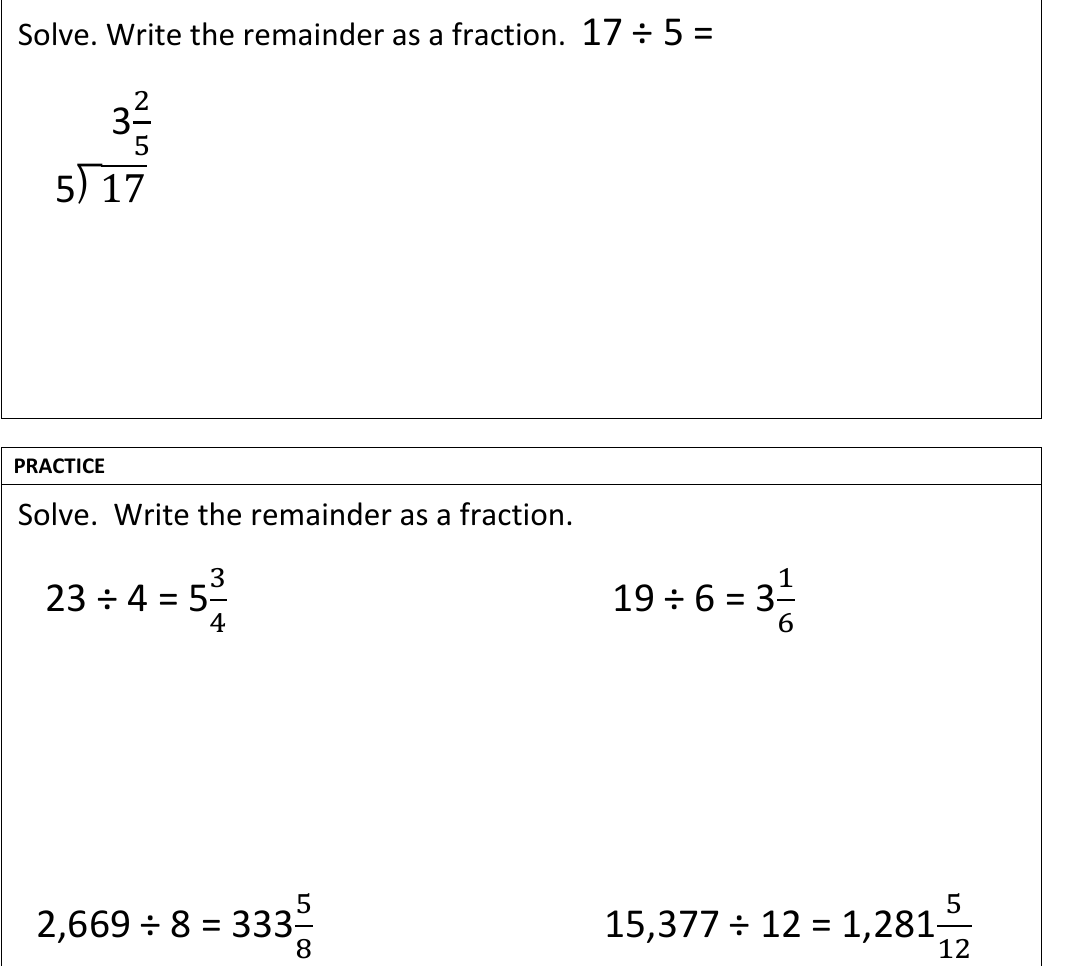
Introduction to Fractions A fraction represents a part of a whole. The numerator is the top number and tells how many equal parts are used. The denominator is the bottom number and tells the total number of equal parts the whole is divided into. nnnnnnnnn ddddddddddd Remainders as Fractions When dividing, the remainder is the amount left over. This can be written as a fraction next to the whole number of the quotient. • Write the remainder as the numerator • Write the divisor as the denominator
Solve. Write the remainder as a fraction. 17 ÷ 5 = 2 3 5

Solve. Write the remainder as a fraction.


Compare and Order Fractions When fractions have the same denominator, compare the numerators. The smaller numerator is the smaller fraction. When fractions have the same numerator, compare the denominators. The fraction with the larger denominator is the smaller fraction.
Use ˂ or ˃ to compare each pair of fractions. 6 8 3 3 ˂ ˃ 15 15 7 10 Put the following fractions in order from least to greatest. 2 2 2 2 2 , , , ,
, , , , 15 10 7 5 3
Use ˂ or ˃ to compare each pair of fractions.
˃ 12 23 5 18 ˂ 11 18 3 20 ˂ 17 20 Put the following fractions in order from greatest to least. 9 15 6 3 20 2 11 , , , , , ,
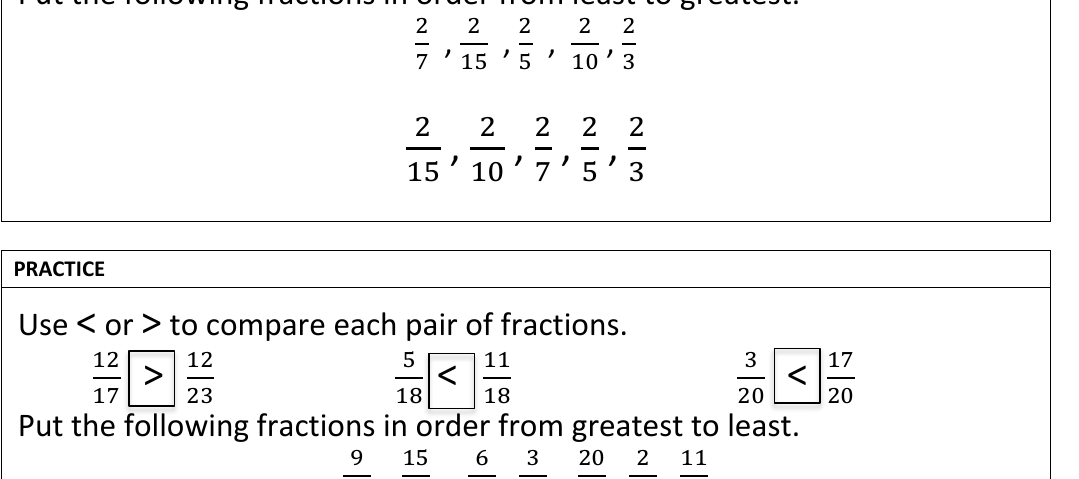
, , , , , , 20 20 20 20 20 20 20
| Work-text | Lesson 31 | Lesson 32 | Lesson 33 | Lesson 34 |
|---|---|---|---|---|
| Speed drill | 31 | 32 | 33 | 35 |
| Term | Meaning |
|---|---|
| greatest | common. The greatest common factor (GCF) is the largest factor |
| common | common. The greatest common factor (GCF) is the largest factor |
| factor | common. The greatest common factor (GCF) is the largest factor |
| largest | common. The greatest common factor (GCF) is the largest factor |
| gcf | • The largest one is the GCF |
| multiple | A multiple of a number is the product of that number multiplied by |
| multiples | a whole number. Common multiples are multiples shared by |
| fraction | A fraction represents a part of a whole. The numerator is the top |