This week
Lessons 71, 72, 73, 74, & 75
More Algebraic Equations
To solve an equation: • Simplify each side if possible • Do the inverse operation • Check
*Reminder: whatever we do to one side of the equation we must do to the other side of the equation, too.
f C - 12 = 9 + 7 = (6)(4) 3
f C - 12 = 16 = 24 3 f + 12 +12 (3)( ) = (24)(3) 3 C = 28 f = 72

N 7k = 105 + 21 = 272 - 8 4
k = 18 N = 1,056
Algebraic Translation
An equation may be written in words and must be translated into an algebraic equation before solving. Usually, the phrase “a number” is used to represent our variable or letter. The word “is” usually translates into an equal sign.
Translate and then solve.
A number plus five is fifteen. N + 5 = 15
The difference of twelve and six is three times a number. 12 - 6 = 3N
2=N
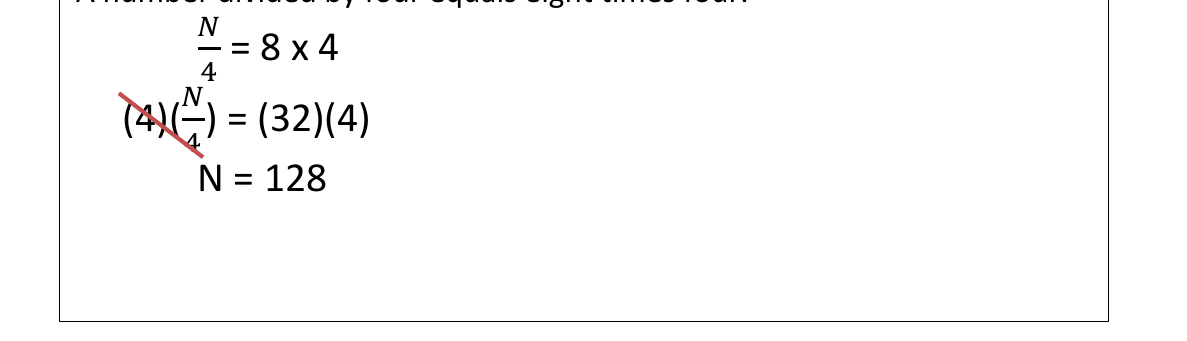
A number divided by four equals eight times four. N =8 × 4 4 N (4)( ) = (32)(4) 4 N = 128
Translate and solve.
A number minus 4 is nine.
N = 13
A number divided by five is twenty.
N = 100
Six times a number is thirty-nine minus three
N=6
Fourteen plus a number is two times nine.
N=4
Line Graphs A line graph shows changes over a period of time.
Frosty's Snowcone Shop Snowcone Sales
300
250
200
150
100
50
0 Sunday Monday Tuesday Wednesday Thursday Friday Saturday
What is the difference in sales between Saturday and Sunday?
250 - 100 = 150 cones
What is the average number of cones sold on weekdays (Monday through Friday)? 175 cones
150+200+125+200+200 5
How many cones were sold on Wednesday? 125 cones
Three-Digit Divisors
To divide with a three-digit divisor:
• Look at the first digit of the divisor to find a starting estimate • Estimate how many times that digit goes into the first few digits of the dividend • Multiply the full divisor by your estimate to check • Compare the result to the dividend. Adjust if needed
Reminder: Estimation will not always give the correct answer on the first try. Trial and error is normal.
Use estimation to find the quotient and then check.
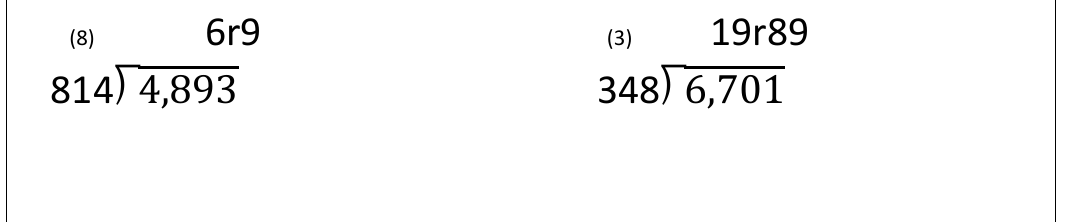
Use estimation to find the quotient and check.

6 r 600 9 r 339
5,634 ÷ 716 = 7 r622 7,329 ÷ 814 = 9 r3
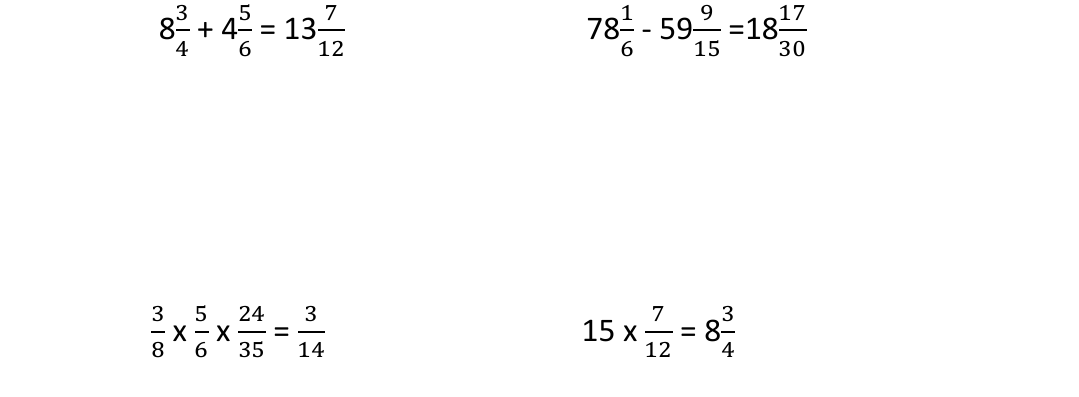
x x = 15 x =8 8 6 35 14 12 4
explain why we estimate the three-digit divisor before dividing. Suggested Answer: "We estimate first because three-digit divisors are too large to easily see how many times they go into the dividend. By looking at just the first digit, we can make a reasonable guess and then check by multiplying. If the guess is too big or small, we adjust."
| Work-text | Lesson 71 | Lesson 72 | Lesson 73 | Lesson 74 | Lesson 75 |
|---|---|---|---|---|---|
| Speed drill | 71 | 72 | 73 | 75 |
| Term | Meaning |
|---|---|
| variable | to represent our variable or letter. The word “is” usually translates into |
| algebraic translation | An equation may be written in words and must be translated into an |