This week
Lessons 80, 81, 82, 83 & 84
*Lessons 76-79 are review and will be covered in week 17 before the midterm exam.
Introduction to Decimals
Decimals are another way of writing a fraction using place value. Reading and writing a decimal is very similar to whole numbers. The decimal point separates the whole number and decimal parts. It is read as the word “and.” The last word is the place value of the last digit.
hundreds Tens ones “and” tenths hundredths thousandths

*Every number has an understood decimal point after the ones digit even if it is not written.
Complete the chart. Standard Form Word Form 1.7 One and seven tenths 305.009 Three hundred five and nine thousandths 0.28 Twenty-eight hundredths 10.205 Ten and two hundred five thousandths
Complete the chart. Standard Form Word Form
5.37 Five and thirty-seven hundredths 15.8 Fifteen and eight tenths 2,025.075 Two thousand twenty-five and seventy-five thousandths 0.532 Five hundred thirty-two thousandths
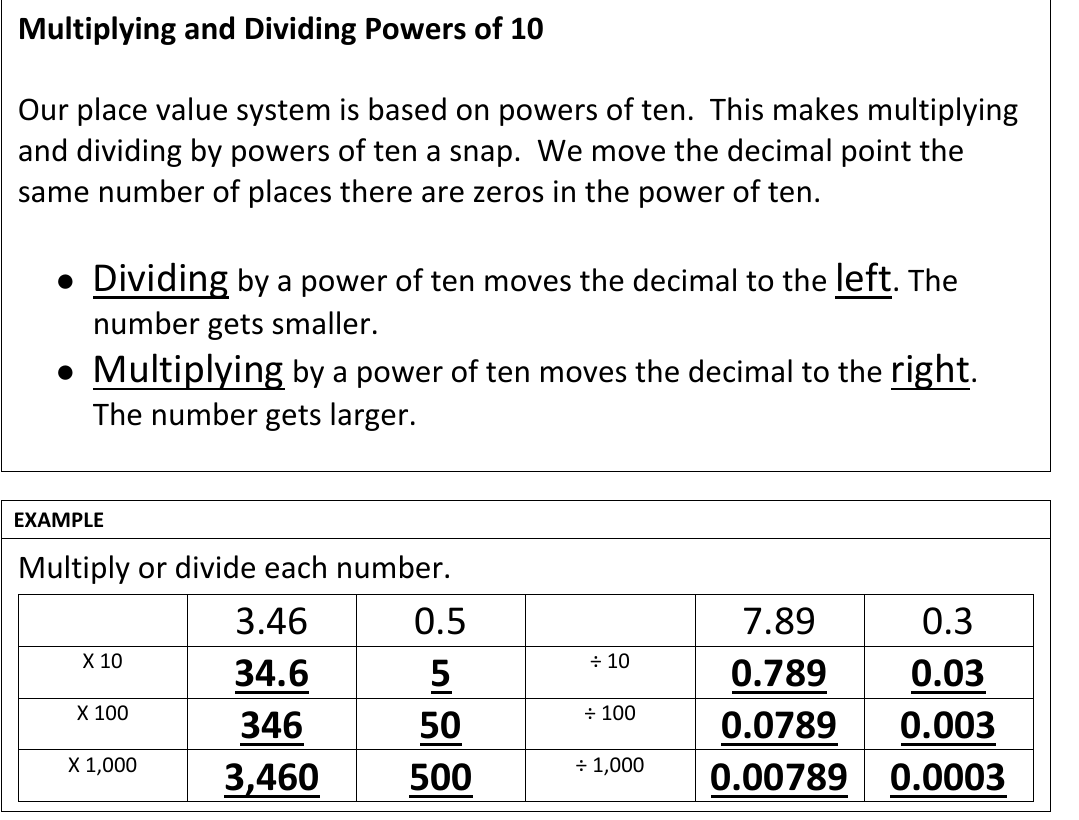
Multiplying and Dividing Powers of 10
Our place value system is based on powers of ten. This makes multiplying and dividing by powers of ten a snap. We move the decimal point the same number of places there are zeros in the power of ten.
• Dividing by a power of ten moves the decimal to the left. The number gets smaller. • Multiplying by a power of ten moves the decimal to the right. The number gets larger.
Multiply or divide each number. 3.46 0.5 7.89 0.3 × 10
Follow the signs to multiply or divide.
5.2 × 10 = 52 7.5 ÷ 100 = 0.075 0.504 × 100 = 50.4
8 ÷ 1000 = 0.008 32.2 × 1,000 = 32,200 17 ÷ 10 = 1.7
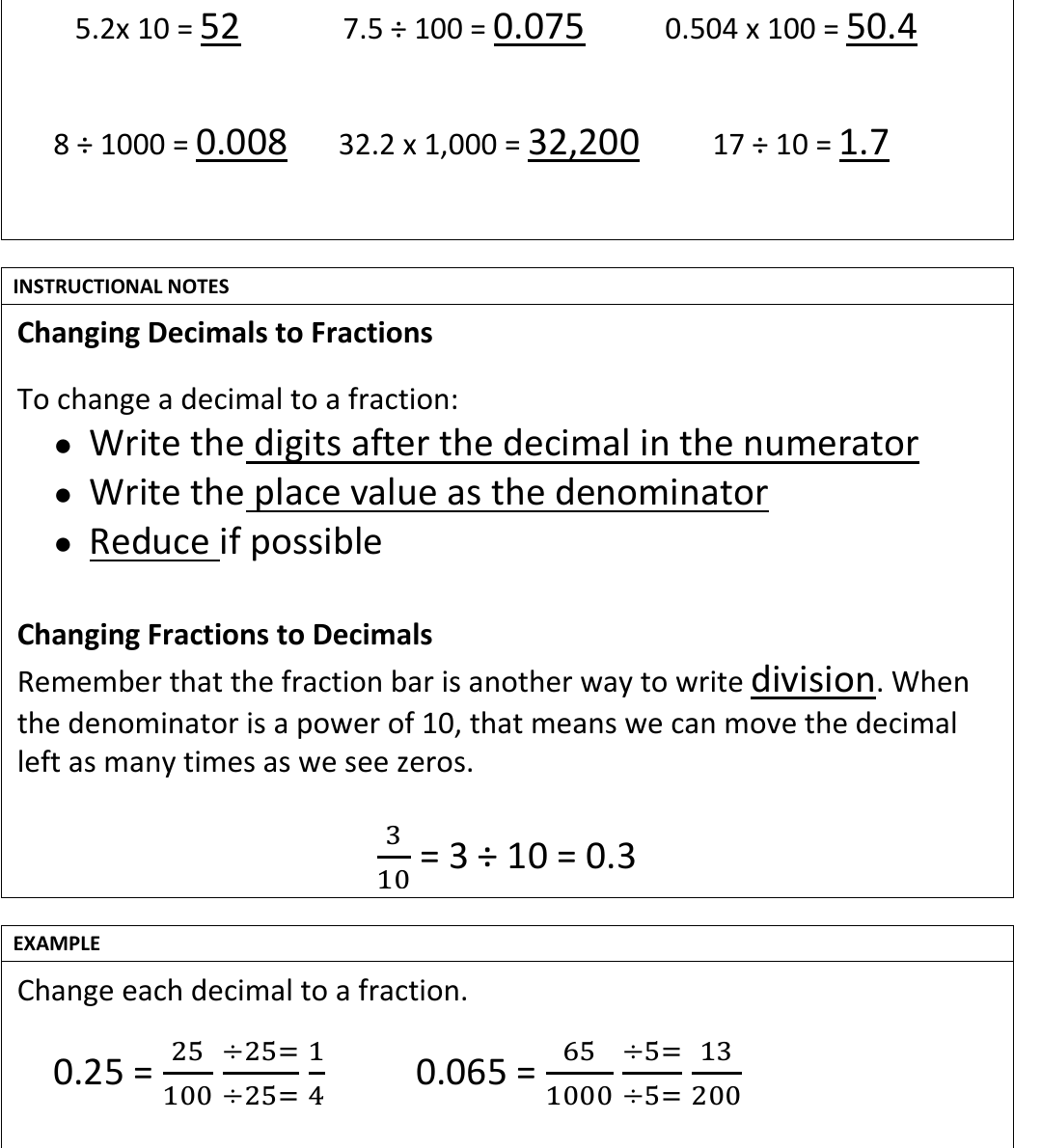
Changing Decimals to Fractions
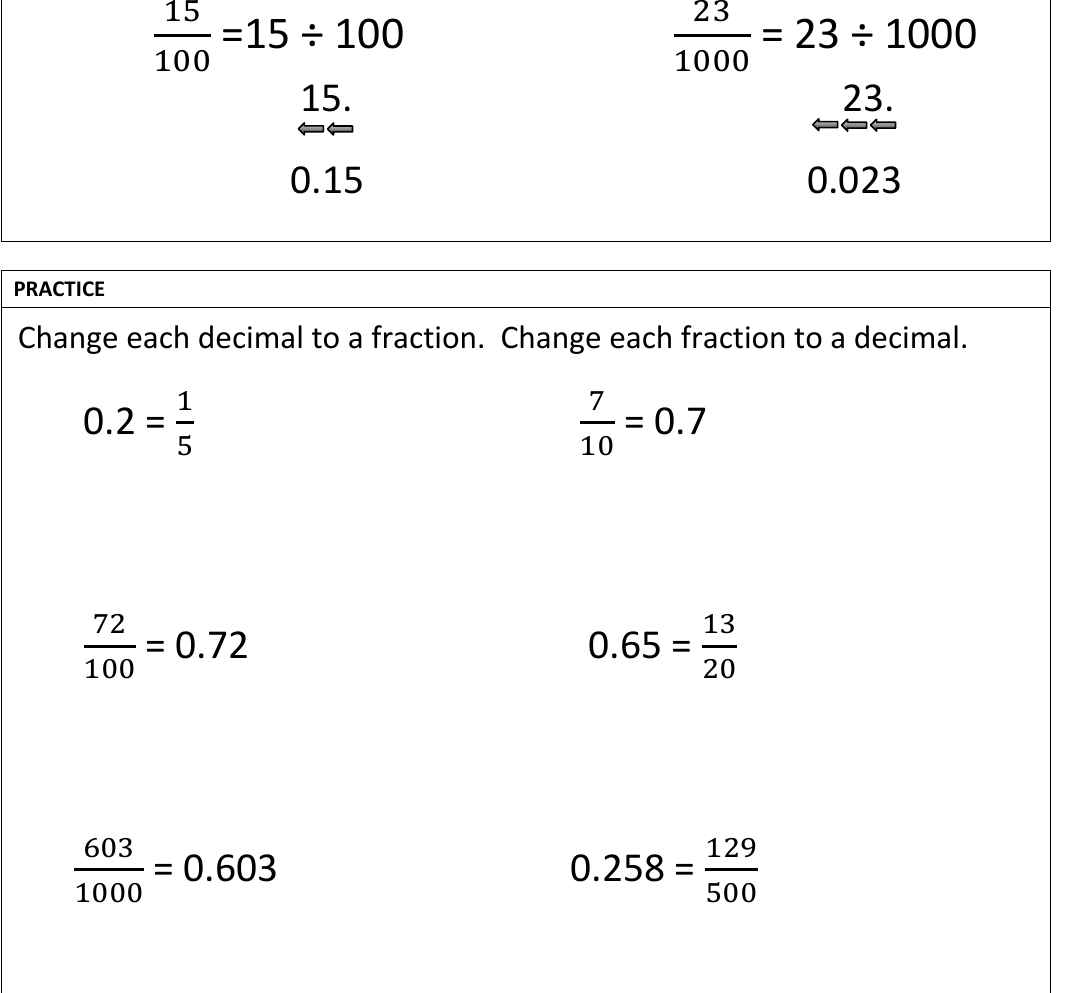
To change a decimal to a fraction: • Write the digits after the decimal in the numerator • Write the place value as the denominator • Reduce if possible
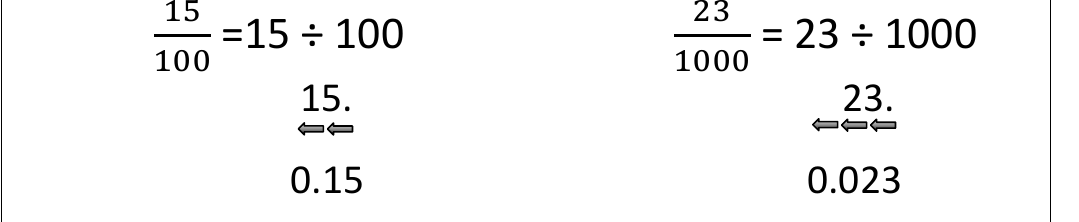
Changing Fractions to Decimals Remember that the fraction bar is another way to write division. When the denominator is a power of 10, that means we can move the decimal left as many times as we see zeros.
3
Change each decimal to a fraction.
Change each fraction to a decimal.
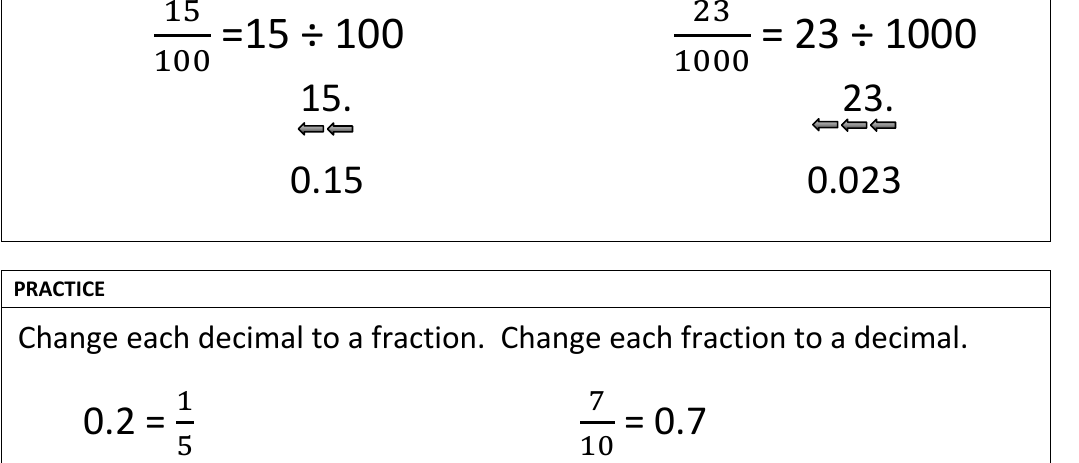
Change each decimal to a fraction. Change each fraction to a decimal.
Comparing Decimals
Decimals are easiest to compare when they have the same number of digits after the decimal. We can add or remove zeros at the end of a decimal without changing its value.
To compare decimals: • Remove or add zeros until decimals have the same number of digits after the decimal • Compare
Compare using <, >, or =

Compare using <, >, or =
0.06 ___ 0.75 5.15 ___ 5.51 < <
0.32 ___ 0.032 4.570 ___ 4.57 > =
0.300 ___ 0.2 0.65 ____ 0.650 > =
Estimating Multiplication
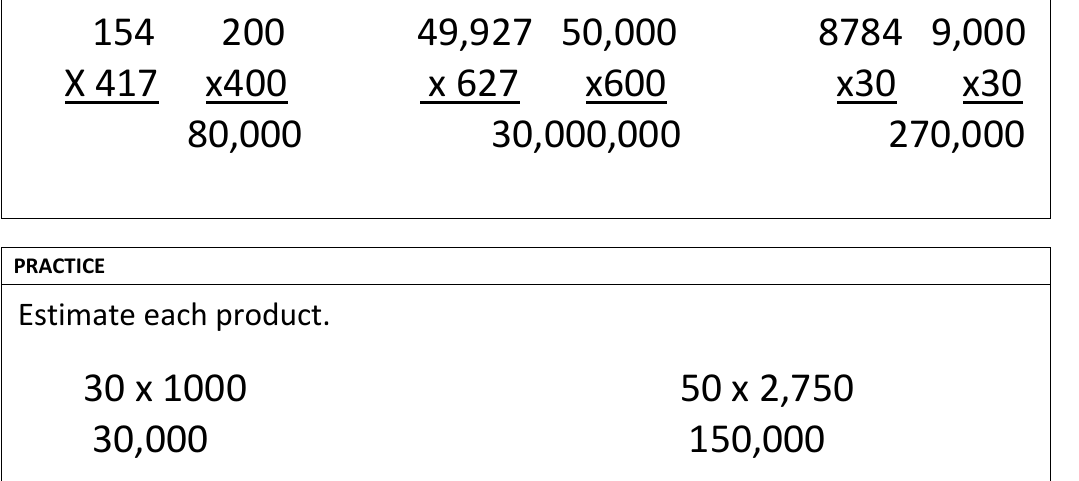
To estimate a product: • Round each factor • Count the total number of zeros • Multiply the non-zero digits • Write the total number of zeros counted after the product
Estimate each product.

Estimate each product.


lb. = ___ oz. 16 pt. = _____ gal. 2 8 2
explain why multiplying or dividing by a power of ten allows us to quickly move the decimal. Suggested answer: Because our number system is a base-10 system, each place value column is worth exactly ten times the column to its right. Multiplying by a power of 10 (like 10, 100, or 1,000) shifts all your digits one place to the left, making them ten times larger. Conversely, dividing shifts digits to the right making them ten times smaller.
| Work-text | Lesson 80 | Lesson 81 | Lesson 82 | Lesson 83 | Lesson 84 |
|---|---|---|---|---|---|
| Speed drill | 80 | 81 | 82 | 83 |
| Term | Meaning |
|---|---|
| value | value. Reading and writing a decimal is very similar to whole numbers. |
| parts | parts. It is read as the word “and.” The last word is the place value of the |
| division | Remember that the fraction bar is another way to write division. When |
| same | Decimals are easiest to compare when they have the same number of |
| comparing decimals | Decimals are easiest to compare when they have the same number of |
| estimating multiplication | To estimate a product: |