This week
Lessons 141, 142, 143, 144, & 145
More on Multiplying with Decimals To multiply with decimals: • Multiply as usual, ignoring decimals
• Count total decimal places in all factors • If the product has fewer digits than decimal places
needed, add zeros to the left • Place the decimal point
Multiply.
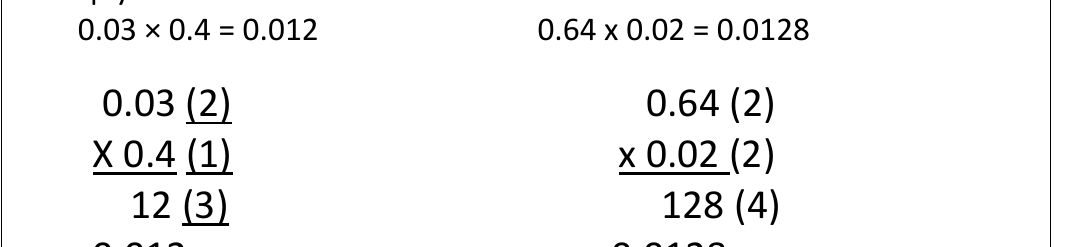
Multiply.
0.07 × 0.5 = 0.035 0.003 × 7 = 0.021
0.12 × 0.4 = 0.048 0.08 × 0.09 = 0.0072
Division with Decimal Divisors
To divide when the divisor is a decimal:
• Shift the decimal in the divisor right to make a whole number • Place a caret where the decimal should be • Shift the decimal in the dividend the same number of
places to the right • Annex zeros as needed
• Place a caret where the decimal should be
• Divide moving the decimal point up into the quotient
Divide.
Divide. 24.6 ÷16.4 = 1.5 132.5 ÷ 0.005 = 26,500
Ratio: shows the relationship between 2 numbers
Antecedent: first number Can be written 3 to 7 Consequent: second number 3 3:7 or 7
Reduce to lowest terms 5 = 15 3 1
4 to 6 = 2 to 3 7:14 = 1:2
Improper fractions should not be 7 3 15 to 1 12:5 changed
Missy knew 14 out of the 105 songs played on the radio. Express the ratio of known to played songs in three ways.

Last month at the animal shelter there were 28 dogs, 4 bunnies and 7 cats.
What is the ratio of bunnies to dogs? 1 4 to 28 = 1 to 7 or 1:7 or 7 1 There were as many bunnies as dogs. 7
There were 4 times as many dogs as cats.
Mr. Poplin has a bag of balls in his classroom. There are 12 red balls, 6 blue balls, and 42 yellow balls in the bag.
Write the ratio of red to yellow balls three ways. 2 2 to 7 2:7 and 7 Write the ratio of blue to non-blue balls three ways. 1 1 to 9 1:9 and 9 There are 7 times as many yellow balls as blue balls.
1 There are as many red balls as non-red balls. 4
what are three concepts that you could ask your teacher to include in the end of year review? Answers will vary.
| Work-text | Lesson 141 | Lesson 142 | Lesson 143 | Lesson 144 | Lesson 145 |
|---|---|---|---|---|---|
| Speed drill | 141 | 142 | 143 | 145 |
| Term | Meaning |
|---|---|
| more multiplying with decimals | More on Multiplying with Decimals |